
Coin Snapshot
- Weight: 13.48 grams
- Composition: 89.24% silver, 10.76% copper
- Diameter: 32.5 mm
- Thickness: Varies
- Years Minted: 1807-1839
- Designed by: John Reich (modified by William Kneass)
- Total Coins Struck: Over 100 million (all years combined)
Overview of the Capped Bust Half Dollar
Issued during a time of rapid growth in the United States, the Capped Bust Half Dollar represents one of the most important and widely used denominations in early American commerce. First introduced in 1807, the series replaced the Draped Bust design and introduced a more distinctly American artistic style. Its large size, high silver content, and durability made it a practical coin for everyday transactions during the early 19th century.
Unlike earlier U.S. coinage, which often struggled with consistency and quality, the Capped Bust Half Dollar benefited from improvements in minting technology and engraving. Produced for over three decades, it became a familiar and trusted form of currency across the country. Today, it remains a cornerstone of early American numismatics, valued for both its historical relevance and its wide range of collectible varieties.
Capped Bust Half Dollar Coin Design
The Capped Bust Half Dollar marked a noticeable shift in design philosophy at the United States Mint. Created by German-born engraver John Reich, the coin introduced a more natural and balanced depiction of Liberty compared to earlier designs. Reich’s work reflected European artistic influence while still maintaining a uniquely American identity.
In the 1830s, modifications were made under Chief Engraver William Kneass, refining certain details and adapting the design for newer minting equipment. These updates helped standardize production and improve overall strike quality.
Obverse Design
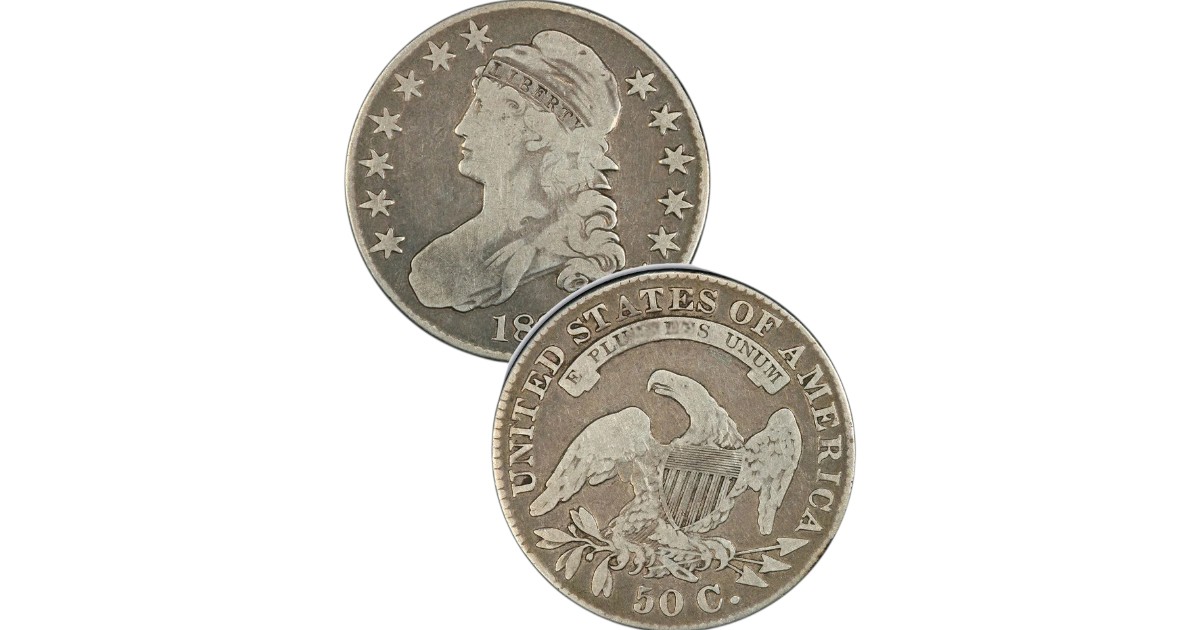
On the obverse, Liberty is shown facing left, wearing a soft cap secured with a band inscribed with the word “LIBERTY.” Her hair flows naturally from beneath the cap, giving the portrait a more lifelike appearance than previous iterations. Surrounding Liberty are thirteen stars, representing the original colonies, while the date is positioned at the bottom of the coin.
The design is simple yet elegant, emphasizing proportion and realism rather than excessive ornamentation. This balance helped set the tone for future U.S. coin designs.
Reverse Design
The reverse features a heraldic eagle with wings outstretched, holding an olive branch in one talon and a bundle of arrows in the other (symbolizing the nation’s desire for peace but readiness for defense). A shield is placed across the eagle’s chest, reinforcing themes of unity and strength.
Encircling the design is the inscription “UNITED STATES OF AMERICA,” along with the denomination “50 C.” on later issues. Earlier versions display “HALF DOL.” as the denomination. The reverse design underwent slight modifications over time, particularly in the size and positioning of lettering and design elements.
Mint Locations and Mintmarks on the Capped Bust Half Dollar
Most of the Capped Bust Half Dollars were minted at Philadelphia and do not have a mintmark. The United States expanded its minting operations beyond Philadelphia in the 1830s, so only a very limited number of these coins were struck at the New Orleans Mint. The mintmarks/mints are listed below:
– Philadelphia (no mintmark)
– New Orleans (O mintmark)
Coins struck in Philadelphia do not bear a mintmark, which was standard practice at the time. The introduction of the New Orleans Mint in 1838 marked an important expansion in coin production, and these coins carry an “O” mintmark on the reverse. During the first year of production at the New Orleans Mint, only approximately 1,200 Capped Bust Half Dollar coins were struck-making it one of the rarest in the series.
Capped Bust Half Dollar Mintage Chart
| Year | Mintmark | Mint Location | Variety | Mintage | Notes |
|---|---|---|---|---|---|
| 1807 | (None) | Philadelphia, PA | (All varieties) | 750,500 | Varieties include: Small/large stars, 50 over 20 and "Bearded Liberty" |
| 1808 | (None) | Philadelphia, PA | 7 Tailfeathers | 1,368,600 | |
| 1809 | (None) | Philadelphia, PA | 8 Tailfeathers | 1,405,810 | |
| 1810 | (None) | Philadelphia, PA | (All varieties) | 1,276,276 | |
| 1811 | (None) | Philadelphia, PA | (All varieties) | 1,203,644 | |
| 1812 | (None) | Philadelphia, PA | (All varieties) | 1,628,059 | |
| 1813 | (None) | Philadelphia, PA | (All varieties) | 1,241,903 | |
| 1814 | (None) | Philadelphia, PA | (All varieties) | 1,039,075 | |
| 1815 | (None) | Philadelphia, PA | (All varieties) | 47,150 | "5 over 2" |
| 1816 | N/A | N/A | (All varieties) | 0 | *No coins struck |
| 1817 | (None) | Philadelphia, PA | (All varieties) | 1,215,564 | |
| 1818 | (None) | Philadelphia, PA | (All varieties) | 1,960,322 | |
| 1819 | (None) | Philadelphia, PA | (All varieties) | 2,208,000 | |
| 1820 | (None) | Philadelphia, PA | (All varieties) | 751,122 | "20 over 19", square/curl base 2, large/small date |
| 1821 | (None) | Philadelphia, PA | (All varieties) | 1,305,797 | |
| 1822 | (None) | Philadelphia, PA | (All varieties) | 1,559,573 | |
| 1823 | (None) | Philadelphia, PA | (All varieties) | 1,694,200 | |
| 1824 | (None) | Philadelphia, PA | (All varieties) | 3,504,954 | |
| 1825 | (None) | Philadelphia, PA | (All varieties) | 2,943,166 | |
| 1826 | (None) | Philadelphia, PA | (All varieties) | 4,004,180 | |
| 1827 | (None) | Philadelphia, PA | (All varieties) | 5,493,400 | |
| 1828 | (None) | Philadelphia, PA | (All varieties) | 3,075,200 | Curled/square base 2, large/small letters, large/small 8s |
| 1829 | (None) | Philadelphia, PA | (All varieties) | 3,712,156 | |
| 1830 | (None) | Philadelphia, PA | (All varieties) | 4,764,800 | |
| 1831 | (None) | Philadelphia, PA | (All varieties) | 5,873,660 | |
| 1832 | (None) | Philadelphia, PA | (All varieties) | 4,797,000 | |
| 1833 | (None) | Philadelphia, PA | (All varieties) | 5,206,000 | |
| 1834 | (None) | Philadelphia, PA | (All varieties) | 6,412,004 | |
| 1835 | (None) | Philadelphia, PA | (All varieties) | 5,352,006 | |
| 1836 | (None) | Philadelphia, PA | (All varieties) | 6,545,000 | |
| 1836 | (None) | Philadelphia, PA | (All varieties) | 1,200 | REEDED EDGE / "50 Cents" on Reverse |
| 1837 | (None) | Philadelphia, PA | (All varieties) | 3,629,820 | REEDED EDGE / "50 Cents" on Reverse |
| 1838 | (None) | Philadelphia, PA | (All varieties) | 3,546,000 | REEDED EDGE / "Half Dol." on Reverse |
| 1838 | O | New Orleans, LA | (All varieties) | 20 | REEDED EDGE / "Half Dol." on Reverse |
| 1839 | (None) | Philadelphia, PA | (All varieties) | 1,392,976 | REEDED EDGE / "Half Dol." on Reverse |
| 1839 | O | New Orleans, LA | (All varieties) | 116,000 | REEDED EDGE / "Half Dol." on Reverse |
Note: Mintages vary significantly by year, and some issues are far scarcer than others.
History of the Capped Bust Half Dollar Coin
The introduction of the Capped Bust Half Dollar came during a period when the United States was refining its coinage system and expanding its economic reach. By the early 1800s, half dollars had become one of the most important denominations in circulation, used extensively in trade both domestically and internationally.
Transition from Draped Bust Design
Before 1807, half dollars featured the Draped Bust design, which had been in use since the late 18th century. While historically significant, the design was seen as outdated and inconsistent in execution. The Mint sought a fresh look that would better represent the growing nation.
John Reich’s design was selected as a replacement, offering a more modern and cohesive appearance. This transition marked one of the earliest major redesigns in U.S. coinage.
Improvements in Minting Technology
During the lifespan of the Capped Bust Half Dollar, the Mint introduced several technological advancements. Early coins were struck using manual screw presses, which often resulted in uneven strikes. By the 1830s, steam-powered presses were introduced, significantly improving efficiency and consistency.
The shift to reeded edges in 1836 also helped prevent clipping; a common practice where small amounts of precious metal were shaved from coin edges.
Role in Everyday Commerce
Half dollars were heavily used in commerce during the early 19th century. Their substantial silver content made them reliable for larger transactions, especially in trade with foreign markets. As a result, many surviving examples show significant wear from circulation.
Capped Bust Half Dollar Prices
The value of a Capped Bust Half Dollar can vary widely depending on its date, condition, and rarity. Common dates in lower grades are relatively accessible, while scarcer issues and high-grade examples can command significant premiums.
Lower-grade coins (Good to Very Good condition) often start in the low hundreds of dollars. Mid-grade examples (Fine to Extremely Fine) typically range from several hundred to a few thousand dollars. High-grade coins, particularly those in Mint State condition, can reach well into the five-figure range or higher.
Rare and Valuable Capped Bust Half Dollars
While many dates are collectible due to the historical significance of the coins combined with the generally low mintage numbers across the Capped Bust Half Dollar series as a whole, certain issues stand out due to their rarity and demand among collectors.
Key Dates and Varieties
Some of the most sought-after coins in the series include minting errors, especially on earlier dates, such as the 1817/4 overdate variety. Overton varieties (a classification system used specifically for Capped Bust Half Dollars) add another layer of collectibility for specialists.
Other sought after varieties/key dates include low-mintage issues from the 1830s, like the 1836 Philadelphia (only 1,200 coins struck) and all of the coins minted in New Orleans (1838-O and 1839-O). For example, only a small fraction of coins were ever minted in New Orleans (about 20 coins 1838 and 116,000 in 1839). Compare that to other years like 1834 (6,412,004) or 1836 (6,545,000) and the overall mintage of over 100,000,000 coins.
Condition Rarity
High-grade examples are particularly scarce due to the heavy circulation these coins experienced. Coins with original luster and minimal wear are highly desirable and often sell for substantial premiums at auction.
Capped Bust Half Dollar Condition and Certification
Because these coins were widely used, most surviving examples show noticeable wear. Finding coins in About Uncirculated (AU) or Mint State (MS) condition can be challenging, especially for earlier dates.
Professional grading services such as PCGS and NGC play an important role in the market, providing authentication and standardized grading. Certified coins often carry higher market confidence and can be easier to buy and sell.
Collectors should pay close attention to strike quality, surface preservation, and originality when evaluating a Capped Bust Half Dollar.
Buying Capped Bust Half Dollars
For collectors, the Capped Bust Half Dollar offers a unique combination of history, artistry, and variety. Whether you are just starting out or building a specialized collection, there are many entry points depending on your budget and goals.
Lower-grade examples provide an affordable way to own a piece of early American history, while advanced collectors may pursue rare dates, high-grade coins, or specific die varieties. As with any collectible coin, purchasing from reputable dealers and prioritizing certified examples can help ensure authenticity and long-term value.
With its long production run and deep historical significance, the Capped Bust Half Dollar remains one of the most rewarding series in all of U.S. coin collecting.